

Complete the missing piece in your smile and improve your quality of life!
Dental implants, a modern and permanent solution for missing teeth, offer many people an aesthetic and functional return. So, who is suitable for this cutting-edge treatment, and how exactly does the process work? AuraDent has compiled all the answers for you, from your oral structure and bone quality to your consultation and post-treatment care. Let's take a detailed look at the steps you can take to regain your smile and improve your quality of life.

Dental implants, one of the greatest achievements in modern dentistry, are a groundbreaking solution for replacing lost teeth. This treatment improves quality of life in many areas, from aesthetic appearance to chewing function, and when applied correctly, offers an experience closest to that of natural teeth. So, who is this impressive treatment suitable for, how does the process proceed, and how do we at AuraDent guide you through this process?
What is a Dental Implant?
Dental implants are artificial tooth roots made of titanium that are surgically placed in the jawbone to replace missing teeth. Over time, these roots fuse with the jawbone, providing a natural support, and crowns, bridges, or dentures made of porcelain or zirconium can be placed on top. They are an ideal solution for a natural smile and strong chewing function .
Who is Suitable for Dental Implants?
Implant treatment is a suitable option for many individuals who are in good general health and have fully developed jawbones (usually aged 18 and over). However, each individual's situation is different, and the most accurate assessment is achieved through a thorough examination by a qualified dentist.
Oral Structure and General Health Status
Before starting treatment, the patient's oral and dental health is thoroughly examined. Gum disease or other oral infections must be resolved before starting treatment. Furthermore, while some chronic diseases (e.g., diabetes, high blood pressure) that are under control do not constitute a contraindication to implant treatment, conditions such as uncontrolled diabetes or serious heart conditions may pose a risk. In such cases, the patient's general health is carefully considered and a treatment plan is developed in consultation with relevant specialists.
Bone Condition and Quality: The Importance of Foundation
One of the most critical factors in implant success is the sufficient volume and density of the jawbone. Because the implant is placed directly into the bone, the bone must be strong enough to hold it firmly. In cases of insufficient bone volume or quality, additional surgical procedures such as bone grafting (bone meal application) or sinus lift (sinus lift) can be used to strengthen the bone structure. At this stage, our specialist physicians at AuraDent use 3D imaging techniques (CT scans) to analyze the condition of your jawbone in detail and offer personalized solutions.
For Anyone With Missing Teeth
From a single missing tooth to multiple or all missing teeth, dental implants offer a wide range of solutions. They replace missing teeth without the need for bridges or damage to adjacent healthy teeth.
How Does the Implant Process Work? A Step-by-Step Roadmap
Implant treatment is a meticulously planned process, typically involving several stages. At AuraDent, we strive to make this process as comfortable and straightforward as possible.
1. Initial Consultation and Detailed Examination 

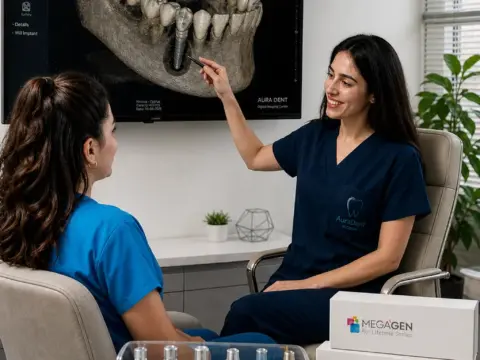
This is the first and most important step in treatment. When you visit our clinic, our doctors will evaluate your oral structure and the health of your teeth and gums. Panoramic X-rays and, if necessary, 3D dental tomography (CBCT) scans are used to thoroughly examine critical anatomical structures such as your jawbone volume, quality, and nerve pathways. This allows us to develop the most appropriate implant placement and treatment plan for you .
2. Bone Condition and Bone Grafting If Necessary

If your jawbone is determined to be insufficient for implant placement, don't worry! Our specialists can strengthen your bone with procedures such as a sinus lift or bone graft to create a solid foundation for the implant. These additional procedures are crucial to the success of the treatment.
3. Implant Placement Surgery

This is a simple surgical procedure performed under local anesthesia (sedation is optional). Your surgeon creates a small implant socket in the jawbone and inserts the titanium implant. There may be some mild swelling or tenderness after the procedure, but this is usually easily controlled with painkillers. At AuraDent, our experienced surgeons perform this procedure under the most delicate and sterile conditions.
4. Healing Process: Osseointegration (Fusing with Bone)

The process of biologically integrating the implant with the jawbone is called "osseointegration," and it typically takes two to six months. During this time, the implant becomes part of the bone, providing a strong foundation for the dental prosthesis that will sit atop it. During this period, temporary prosthetics can be used to maintain aesthetics and chewing function.
5. Preparation and Installation of the Superstructure

Once the osseointegration process is complete, an abutment is placed over the implant. The abutment provides the connection between the implant and the denture. Then, a porcelain or zirconium crown, bridge, or denture, crafted in the laboratory to your oral structure and aesthetic expectations, is permanently placed on the implant. This allows you to achieve both aesthetic and functional restorations of your natural teeth.
Why is Implant Brand Selection Important?
There are many different implant brands on the market. Choosing a high-quality, scientifically proven brand is crucial for the success and longevity of your treatment. At AuraDent, we guarantee the best results by choosing reliable, high-quality implant brands recognized by international standards. Remember, a poor-quality implant can lead to significant long-term problems, including poor fit.
Who is Not Suitable for Implant Treatment?
Although implant treatment is suitable for many people, certain conditions may restrict or prevent the use of this treatment:
- Those with uncontrolled diabetes, serious heart conditions, or immune system diseases.
- Young people (usually under 18 years of age) whose jawbone development is not yet complete.
- People who smoke heavily and consume alcohol (may negatively affect the healing process).
- Patients who have recently received radiotherapy to the jaw area.
- Those taking medications that affect bone metabolism, such as bisphosphonates.
- Women during pregnancy.
These situations are evaluated in detail by our specialist physicians when making treatment decisions.
Post-Implant Care and Longevity

To ensure your implants remain healthy for many years, it's crucial to take care of them after treatment. Just like your natural teeth, your implants should be cleaned regularly and correctly by brushing and flossing. Furthermore, regular checkups at the intervals determined by your AuraDent dentists are crucial for early detection and resolution of potential problems.
Scientific Research and Proven Benefits
Dental implants are a treatment method with a high success rate, supported by decades of scientific research. Thanks to modern implant materials and surgical techniques, implants have a very high rate of integration with the jawbone. This proves that implants are a long-term, durable, and reliable solution . At AuraDent, we always stay abreast of the latest scientific advancements and offer our patients the best treatment options.
At AuraDent Aesthetic Clinic, we are committed to providing you with transparent, informative, and personalized service throughout the implant treatment process. Don't hesitate to contact our specialists to reshape your smile and achieve a healthy oral structure. Remember, a healthy smile is the key to a happier life!
Frequently Asked Questions